
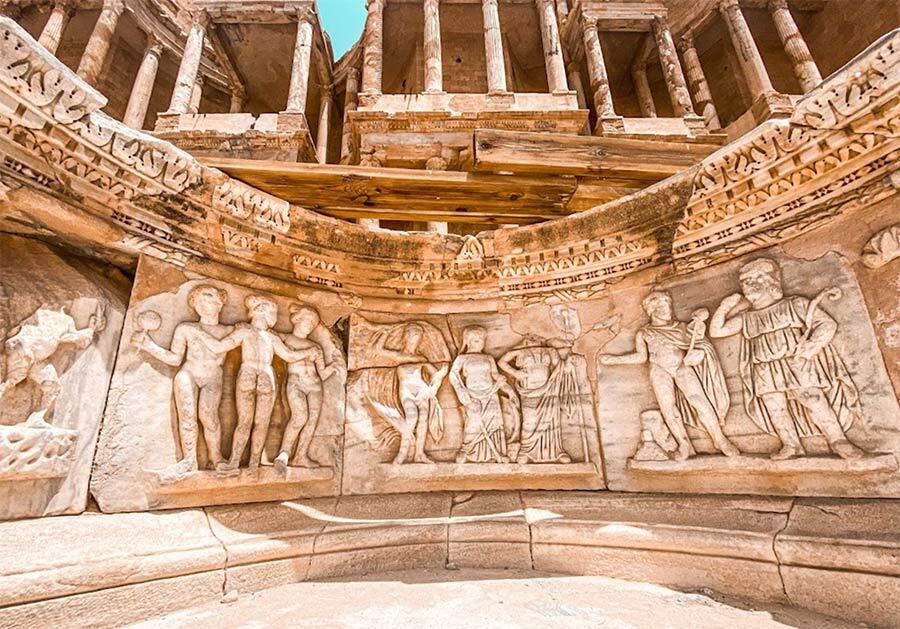
Leptis Magna is one of the most complete Roman cities anywhere in the Mediterranean, and it lies within easy reach of Tripoli. Set on the coast near Al Khums, east of the capital, the site stretches from an ancient harbour to an amphitheatre and a circus beside the sea. Walking its paved streets, you pass a monumental arch, public baths, a marketplace and a theatre, all built in a warm, golden stone that glows in the early light. For Libyans it is a source of pride; for visitors from abroad it is often the very reason they first think of travelling to Libya. In this guide, our team explains what makes Leptis Magna special, which monuments you should not miss and how to plan a comfortable visit.
Why Leptis Magna matters
The city began as a Phoenician trading port and grew into one of the leading cities of Roman Africa. Its fortunes changed when one of its sons, Septimius Severus, became emperor of Rome. He honoured his birthplace with an ambitious building programme that transformed its centre, and much of what visitors admire today belongs to that period. Because the city was later abandoned and partly covered by sand for centuries, many of its structures survived in remarkable condition. In 1982 UNESCO inscribed Leptis Magna on its World Heritage List, recognising it as an outstanding example of Roman urban planning.
What strikes most visitors is the scale. This is not a single temple or a few columns in a field, but an entire city whose streets, squares and public buildings can still be read on the ground. You can follow the rhythm of daily life: where people traded, bathed, gathered for entertainment and met to settle their affairs.
The monuments you should not miss
A full visit takes several hours, and a good guide will help you link the different areas into one story. These are the highlights most travellers remember long after they return home:
- The Arch of Septimius Severus, a four-sided monumental arch at a main crossroads, decorated with carved scenes celebrating the emperor and his family.
- The Hadrianic Baths, a vast bathing complex with cold, warm and hot rooms, a large open-air pool and traces of the marble that once covered the walls.
- The Severan Forum and Basilica, a huge public square once framed by colonnades and famous for its carved heads of Medusa, with a grand basilica beside it decorated with richly sculpted pilasters.
- The theatre, one of the most photographed places on the site, with its tiers of seats facing the stage and the sea beyond.
- The market, where two round pavilions stood in the middle of a courtyard lined with stalls, a vivid reminder of the city's commercial life.
- The harbour, whose quays, warehouses and remains of a lighthouse show how Leptis Magna was connected to the wider Mediterranean.
- The amphitheatre and the circus by the sea, a short distance east of the centre, where crowds gathered for games and chariot races.
Leave time to simply walk the colonnaded street and the quieter side lanes. Some of the most memorable moments come from small details: an inscription, a carved capital, a fragment of mosaic or a glimpse of the sea between two columns.
Practical tips for your visit
Leptis Magna is an open-air site with very little shade, so good preparation makes a real difference to how much you enjoy the day. Our guides share the same advice with every group:
- Start early in the morning, when the light is soft and the temperature is more comfortable for walking.
- Carry plenty of water, even in the cooler months.
- Protect yourself from the sun with a hat, sunglasses and sunscreen.
- Wear comfortable closed shoes with a good grip, as the ancient paving can be uneven.
- Visit with a licensed local guide who can explain the history and lead you between the main areas without wasting energy.
- Check opening hours and visiting conditions with our team before you go, as they can change.
Spring and autumn are usually the most pleasant seasons, but an early start makes a visit enjoyable for much of the year. Families with children and older travellers can enjoy the site as well, provided the pace is adapted and rest breaks are planned along the way.
A day trip from Tripoli with our team
We organise day trips to Leptis Magna from Tripoli for families, groups, schools and business travellers who want to make the most of a free day. A typical trip includes comfortable transport with a professional driver, a licensed guide on site and a relaxed schedule that leaves time for photographs and questions. Many travellers like to add lunch in the area or a short stop on the coast on the way back.
For visitors coming from abroad, Leptis Magna fits naturally into a wider tour of Libya, together with the old city of Tripoli and the Roman site of Sabratha, west of the capital. Our team can advise on the order of visits, the best time of day and the arrangements that suit your group, from a small family to a large delegation.
Getting the most out of the experience
A little preparation goes a long way. Reading a short history of Roman Africa before the trip, or asking your guide to explain how a Roman city was organised, turns a walk among ruins into a lesson you will not forget. Photographers should plan for the morning light on the arch and the forum, and for the sea views from the theatre. Above all, take your time: Leptis Magna rewards those who stop, look closely and let the place tell its story.
Would you like to discover Leptis Magna with a licensed guide and comfortable transport from Tripoli? Contact our team at Asfar Booking and we will plan a day trip at the pace that suits you, your family or your group.